
Definition: Resolving customer issues during the first interaction, eliminating the need for follow-ups or transfers.
FCR vs. OCR: While FCR tracks single-channel success, One-Contact Resolution (OCR) tracks the entire journey. OCR is typically 11% lower than FCR due to channel switching.
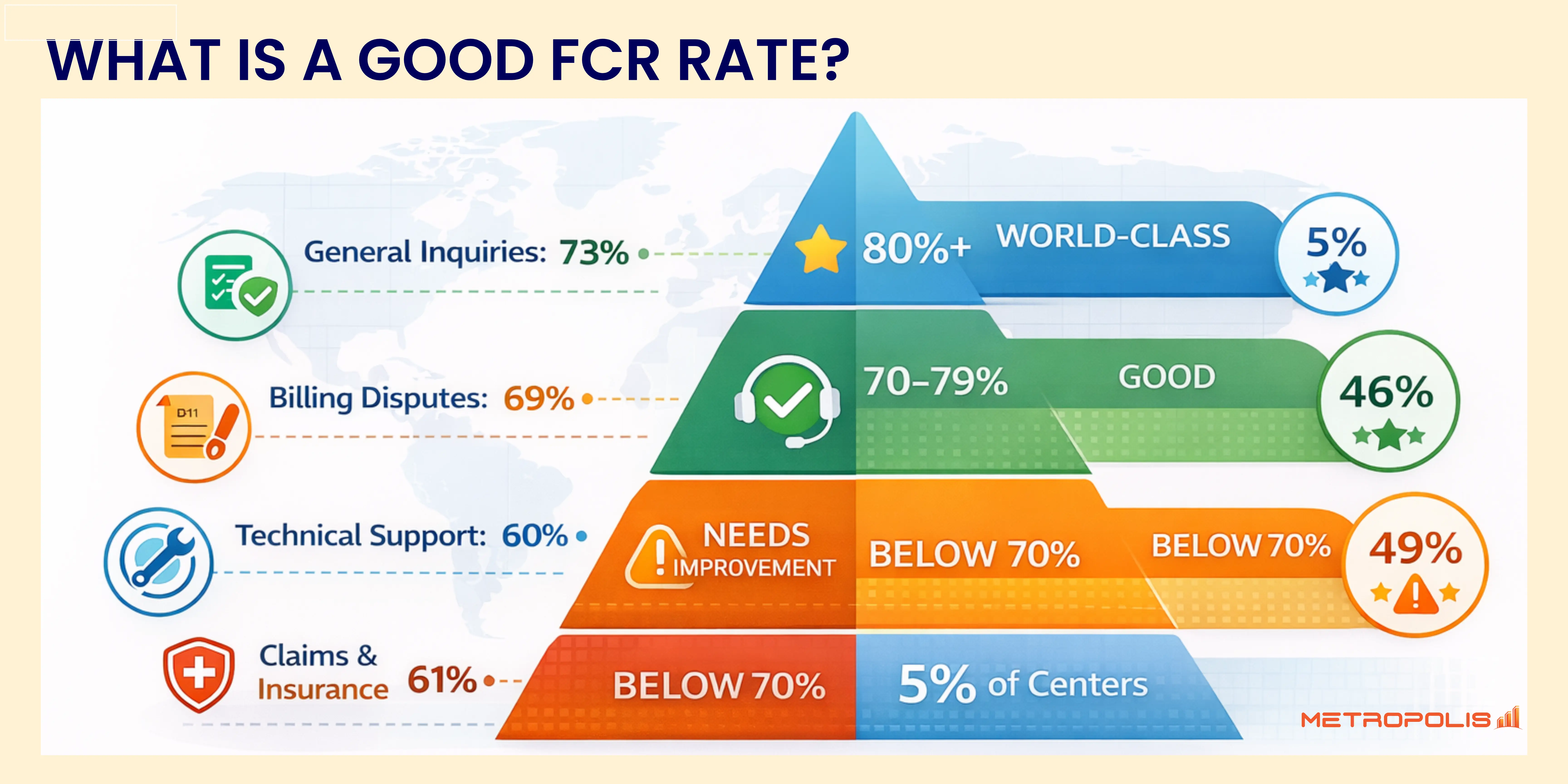
Benchmarks: 70–79% is "Good," but only 5% of centers achieve "World-Class" status at 80%+.
Top Strategy: Sustainable improvement requires moving beyond "agent coaching" toward AI-assisted knowledge management and system integration.
First Call Resolution (FCR) AKA First Contact Resolution is a call center KPI that measures the percentage of customer issues resolved completely during the first interaction. High FCR reduces operating costs, increases customer satisfaction, and improves agent morale—making it one of the most powerful indicators of contact center effectiveness.
At its core, FCR measures whether a customer’s issue was resolved during their first interaction. However, the term "first call" is becoming a misnomer. In 2024, FCR encompasses voice, chat, email, and social media.
The FCR vs. OCR Distinction: Roughly 40% of customers switch channels while resolving a single issue. This has led to the rise of One-Contact Resolution (OCR). While FCR might look high for your phone team, your OCR might be significantly lower (averaging 59% industry-wide) if customers are starting on chat and finishing on a call.
FCR is frequently overstated due to differences between how customers perceive resolution and how systems record it. Internal measurements often assume that silence equals satisfaction; customers frequently disagree.
Measurement Method |
Description |
Accuracy |
Common Issue |
|---|---|---|---|
Customer-Reported (Survey) |
Asks customers if their issue was resolved |
High fidelity |
Low response rates (7–15%) |
No-Repeat-Call Tracking |
Assumes no callback = resolved |
Medium |
Inflates FCR by 10–20% |
Agent Self-Reported |
Agents mark resolution at call end |
Low |
Strong response bias |
Across industries, average FCR ranges between 69–71%. Benchmarks are directional; a 72% FCR may be excellent for technical support but underperforming for simple retail inquiries. According to 2024-2025 research, FCR varies wildly by interaction type
General Inquiries: 73% FCR
Billing Disputes: 69% FCR
Technical Support: 60% FCR
Claims/Insurance: 61% FCR
Performance Level |
FCR Rate |
Distribution |
|---|---|---|
Needs Improvement |
Below 70% |
49% of Centers |
Good |
70–79% |
46% of Centers |
World-Class |
80%+ |
5% of Centers |
 >
>
Improving First Call Resolution requires removing the systemic barriers that prevent issues from being resolved the first time. The most effective FCR improvements consistently fall into four core areas.
Knowledge gaps are the most common reason issues remain unresolved on the first interaction. Even high-performing agents struggle when information is hard to find or disconnected.
Centralize Knowledge: Deploy a searchable, AI-indexed knowledge base embedded directly into the agent desktop.
Context-Aware Guidance: Use real-time call center analytics to surface relevant policies automatically.
Decision Authority: Grant agents predefined resolution limits (credits, refunds) without supervisor approval.
Micro-metrics to track: Knowledge Article Usage Rate, Time-to-Answer (TTA), Escalation Rate.
Repeat calls often occur because processes force unnecessary handoffs. Every transfer reduces the probability of first-call resolution.
Eliminate Information Redundancy: Pass IVR and digital-channel data to agents via screen pops so customers do not repeat information.
Reduce Forced Escalations: Redesign workflows so agents can complete common resolutions end-to-end.
Align Metrics with Resolution: Ensure agents are not penalized for spending the time required to fully resolve an issue.
Micro-metrics to track: Transfer Rate, Repeat Contact Rate (Same Issue), Customer Effort Score (CES).
Fragmented systems force agents to context-switch between applications, increasing handle time and cognitive load.
Unified Agent Desktop: Integrate CRM, billing, and prior interactions into a single interface.
Interaction History Visibility: Ensure agents can see prior calls, chats, and emails related to the same issue.
Micro-metrics to track: Average Systems Accessed per Call, Context-Switch Time, Data Completeness Rate.
Traditional QA samples a small fraction of interactions. Modern analytics enable teams to identify unresolved intent across 100% of interactions.
AI-Driven QA: Analyze 100% of calls using speech and text analytics instead of manual samples.
Root-Cause Identification: Distinguish between agent issues, process gaps, and product defects.
Micro-metrics to track: Unresolved Intent Rate, Repeat-Call Prediction Accuracy, Top Repeat-Call Drivers.

First Call Resolution is one of the strongest levers for cost control and customer experience improvement in the contact center. For a 500-agent operation, a 1% improvement in FCR can generate approximately $286,000 in annual savings by reducing repeat contacts and wasted handle time.
Beyond cost, FCR directly influences customer loyalty. On average, a 1% increase in FCR correlates with a 1.4-point increase in Net Promoter Score (NPS). Customers value resolution more than speed—and each additional contact significantly erodes satisfaction.
A: First Call Resolution (FCR) is a call center KPI that measures the percentage of customer issues resolved completely during the first interaction, without requiring follow-up calls, transfers, or escalations.
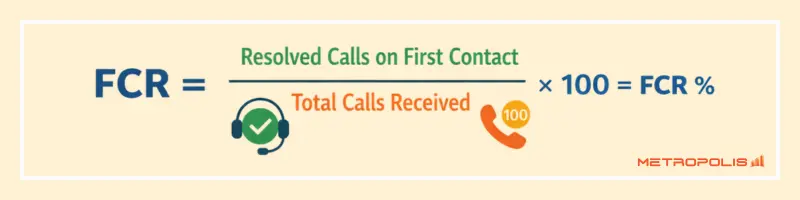
A: The First Call Resolution formula is calculated as: (Issues Resolved on First Contact ÷ Total Customer Issues) × 100.
A: Across most industries, a First Call Resolution rate between 70–79% is considered good, while 80% or higher is considered world-class. Benchmarks vary by industry and interaction complexity.
A: First Call Resolution measures whether a customer issue was resolved during the first interaction, while CSAT measures how satisfied the customer felt about the experience.
A: When implemented correctly, improving First Call Resolution reduces repeat contacts and lowers total handle time across the contact center, rather than increasing it.
A: No. Some issues (claims, complex technical repairs) inherently require multiple steps. Focus on "Optimally Efficient Resolution" rather than an impossible 100% target.
A: Usually, but not always. An agent could resolve an issue on the first call but be rude or dismissive. FCR measures the outcome, while CSAT/NPS measure the experience.
Equip your team with the granular analytics needed to identify repeat-call drivers and boost resolution rates.
Explore Expo XT Analytics


