Understanding Agent Occupancy for Modern Call Centers
Agent Occupancy: A Definition
Agent occupancy is the percentage of logged-in time agents spend on live interactions and after-call work (ACW). While 100% seems efficient, the industry "Goldilocks Zone" is 75–85%. Going higher leads to burnout; lower signals overstaffing.
What is Agent Occupancy?
Agent occupancy is a critical "balancing act" metric in workforce management (WFM) that links staffing levels, operational costs, customer experience, and agent well-being.
Agent occupancy measures the share of an agent's logged-in time spent on "contact-related" activity (Talk, Hold, and After-Call Work) versus "idle" time spent waiting for calls. In the context of Outcome-Centric KPIs, occupancy is the primary indicator of whether your staffing levels match your customer demand.
What Does Agent Occupancy Measure?
In practical terms, Agent Occupancy answers a fundamental question: "When agents are at their desks and available to work, what share of that time is actually spent handling customer needs?" This Key Performance Indicator (KPI) is helpful for call centers to assess:
Workforce Planning: It reveals if staffing is accurately aligned with forecasted demand.
Cost Control: Since labor is the largest expense in a contact center, occupancy indicates how intensively that labor is used.
Experience Correlation: Low occupancy often results in excellent service levels (but high costs), while excessively high occupancy leads to long wait times and agent fatigue.
Agent Occupancy Formula & Calculation
To calculate agent occupancy correctly, you must distinguish between time spent on customers and total time signed into the queue.
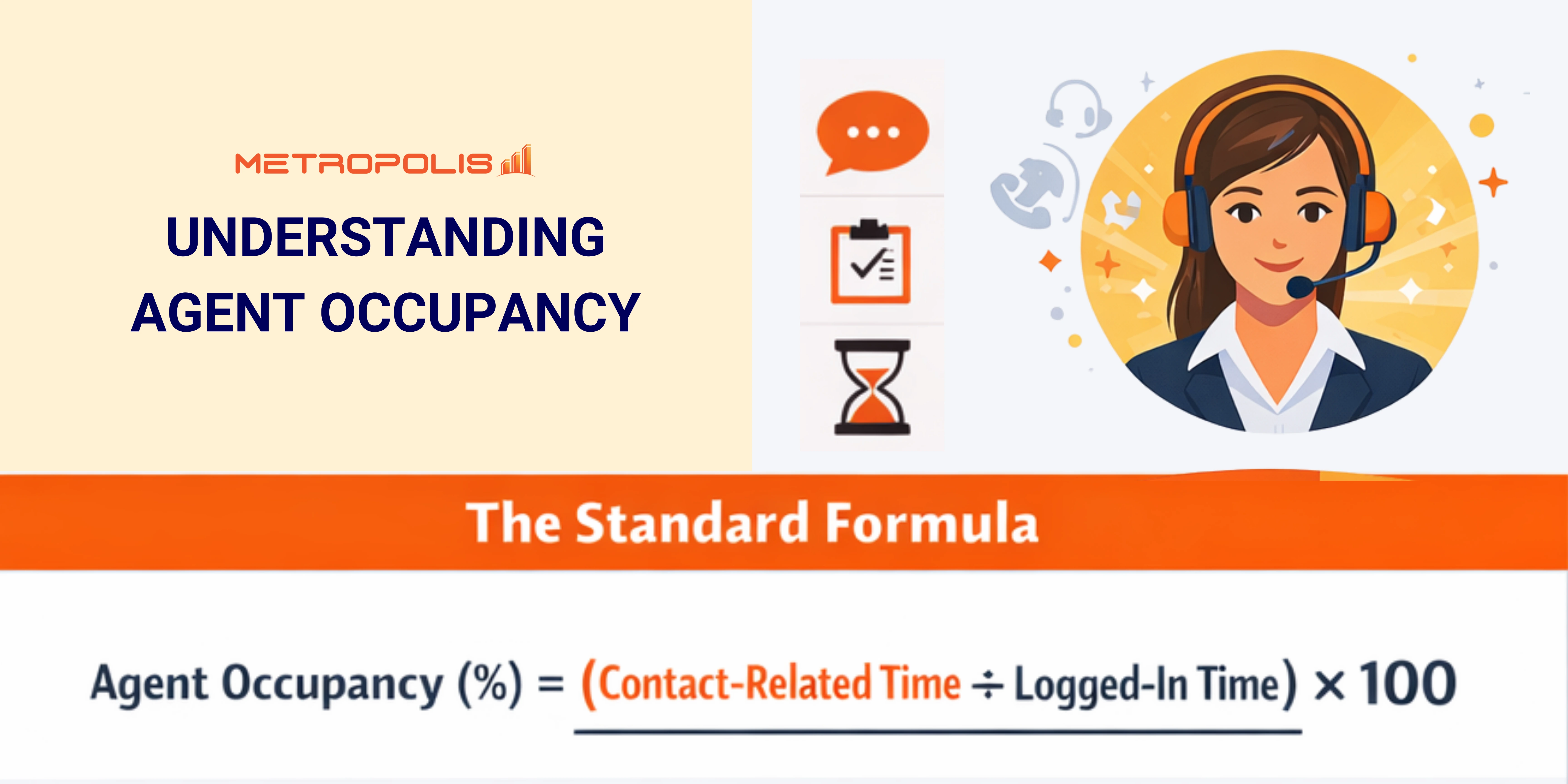
The Standard Formula
Agent Occupancy (%) = (Contact-Related Time ÷ Logged-In Time) × 100
Key Variables:
Contact-Related Time: Includes Talk Time, Hold Time, and After-Call Work (ACW).
Logged-In Time: The total time an agent is signed into the platform and available to receive or process contacts.
Example Calculation
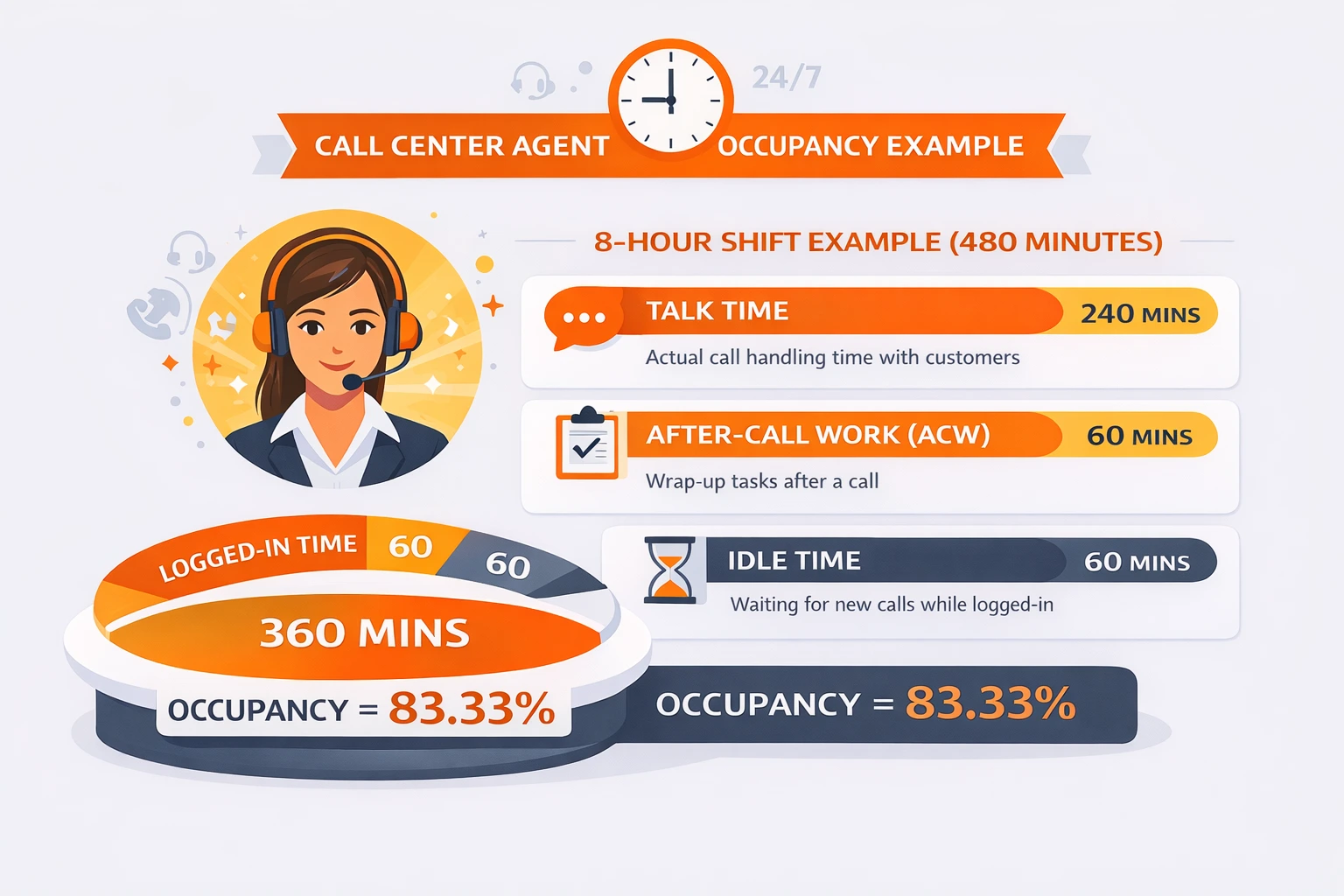
Imagine an agent in an 8-hour shift (480 minutes) with the following breakdown:
Talk Time: 240 minutes
ACW: 60 minutes
Idle Time (Waiting for calls): 60 minutes
Logged-In Time: 360 minutes (Talk + ACW + Idle)
Their calculated Agent Occupancy rate would be: (240 + 60) ÷ 360 × 100 = 83.33%
Agent Utilization vs. Agent Occupancy
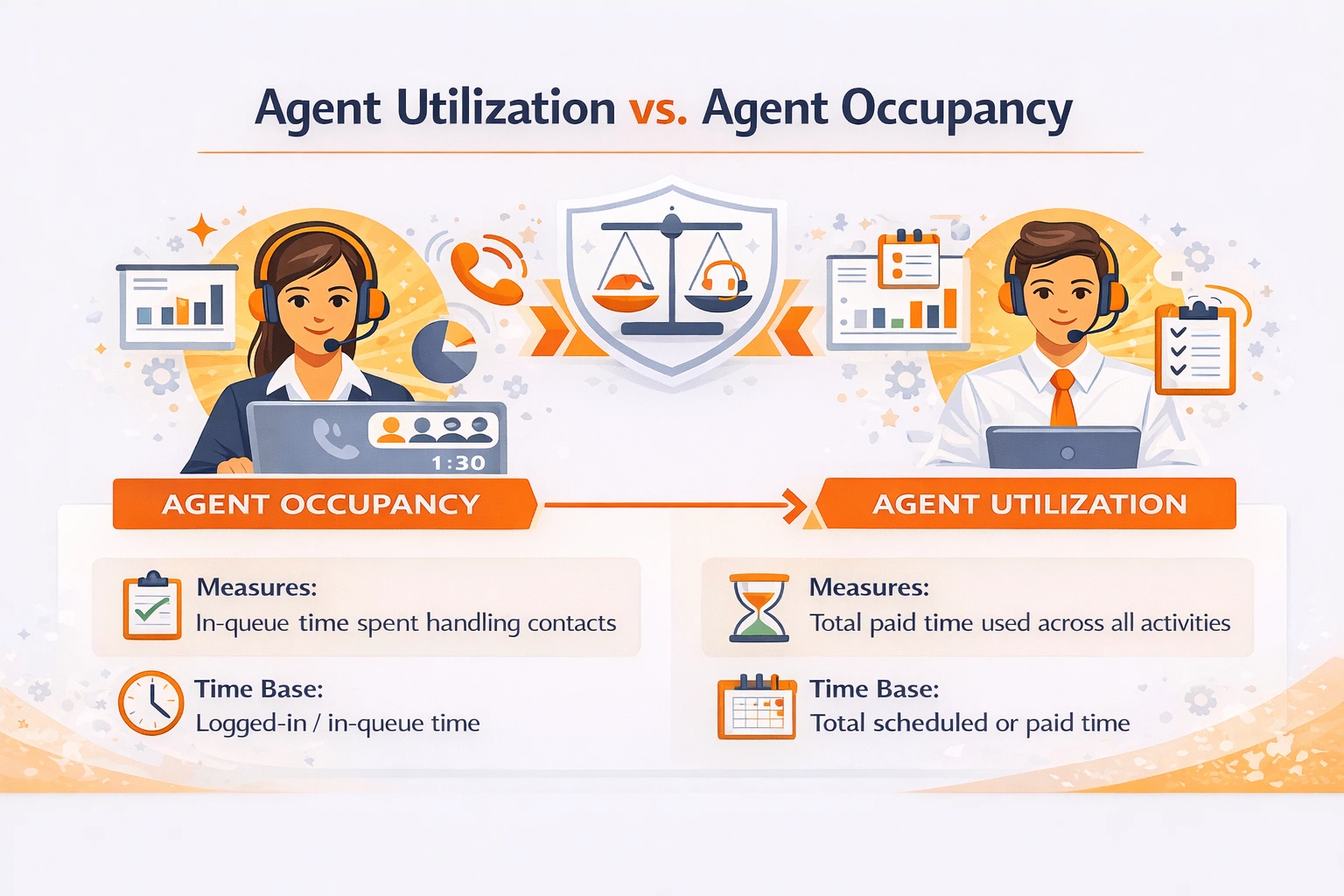
Agent utilization and agent occupancy are closely related but answer different management questions.
Agent occupancy shows how busy agents are while they are logged in and available to handle contacts. It helps managers understand real-time workload and whether staffing levels are properly aligned to demand.
Agent utilization shows how total paid time is used across all activities, including calls, meetings, training, and administrative work. It helps leaders evaluate labor efficiency and long-term capacity planning.
| Metric | What It Measures | Time Base | Primary Use |
|---|---|---|---|
| Agent Occupancy | How much in-queue time is spent handling contacts | Logged-in / in-queue time | Short-term staffing, intraday management |
| Agent Utilization | How total paid time is spent | Total scheduled or paid time | Capacity planning, budgeting |
How it impacts a call center: An agent could have high utilization (spending their whole day in training and meetings) but low occupancy if the few hours they spend in the queue are very quiet.
What is Considered a Low Agent Occupancy Rate?
There is no universal "perfect" number, but industry benchmarks generally suggest:
Target Range: 75%–85% is considered a healthy balance for inbound centers.
Low Occupancy (<65%–70%): Typically indicates structural overstaffing, over-forecasted volume, or fragmented queues.
High Occupancy (>85%–90%): A "warning zone" where agents have no recovery time between calls, leading to burnout.
The AI Agent Impact As AI increasingly automates simple, low-effort inquiries, the "leftover" calls for human agents are becoming more complex. To prevent burnout, organizations may need to lower their traditional occupancy targets to account for this increased "cognitive load."
How to Reduce Agent Occupancy Downtime
"Occupancy downtime" is the idle period where agents are available but waiting for contacts. Reducing this requires a mix of better forecasting and flexible operations.
1. Master the Erlang C Model
Use advanced analytics to refine your Erlang C forecasting. By tracking 15-minute interval data, IT teams can identify "dead zones"—predictable times when occupancy drops below 60%.
2. Implement Strategic Multi-Skilling
When one queue is idle, cross-trained agents should automatically receive contacts from busier channels. This "blended" approach stabilizes occupancy without increasing headcount.
3. Dynamic "Micro-Break" Management
Instead of rigid schedules, use real-time occupancy alerts. If occupancy is low, push mandatory training or administrative tasks to agents immediately to ensure downtime is utilized productively.
Improving Occupancy Using Analytics and Dashboards
Advanced analytics platforms, like Expo XT, transform raw Call Detail Records (CDRs) into actionable insights to stabilize occupancy.
Interval-Level Analysis: Track occupancy in 15- or 30-minute blocks rather than daily averages to identify recurring underuse windows.
Intraday Management: Use real-time dashboards to trigger "playbooks"—such as activating offline tasks—when occupancy deviates from the target.
Correlation Tracking: Pair occupancy with First Call Resolution (FCR) and CSAT. If occupancy rises and quality falls, you have reached the point of diminishing returns.
Shrinkage Analysis: Understand how much of the day is available for occupancy by monitoring meetings and unplanned absenteeism.
The AI Impact: Why "Healthy" Occupancy is Changing
As AI Agents automate routine tier-1 inquiries, human agents are left with high-emotion, high-complexity calls. This increases "Cognitive Occupancy"—the mental tax of being "busy." Modern managers should consider lowering occupancy targets to 70–80% in AI-heavy environments to prevent attrition.
Learn more about Measuring AI vs Human Agent Performance in Hybrid Call Center Environments.
FAQs about Occupancy:
Q: What is a low agent occupancy rate?
A: Anything below 65–70% typically suggests overstaffing or a failure in forecasting.
Q: Can agent occupancy be too high?
A: Yes. Sustained occupancy above 90% is a leading cause of agent burnout and high turnover.
Q: Does occupancy include training?
A: No. Training is part of Utilization. Occupancy only counts time spent "in the queue" ready to take calls.
Ready to Improve Your Call Center with Performance Analytics?
Get the agent performance data and KPI's you needto balance agent workload and customer experience.
Explore Expo XT Analytics


